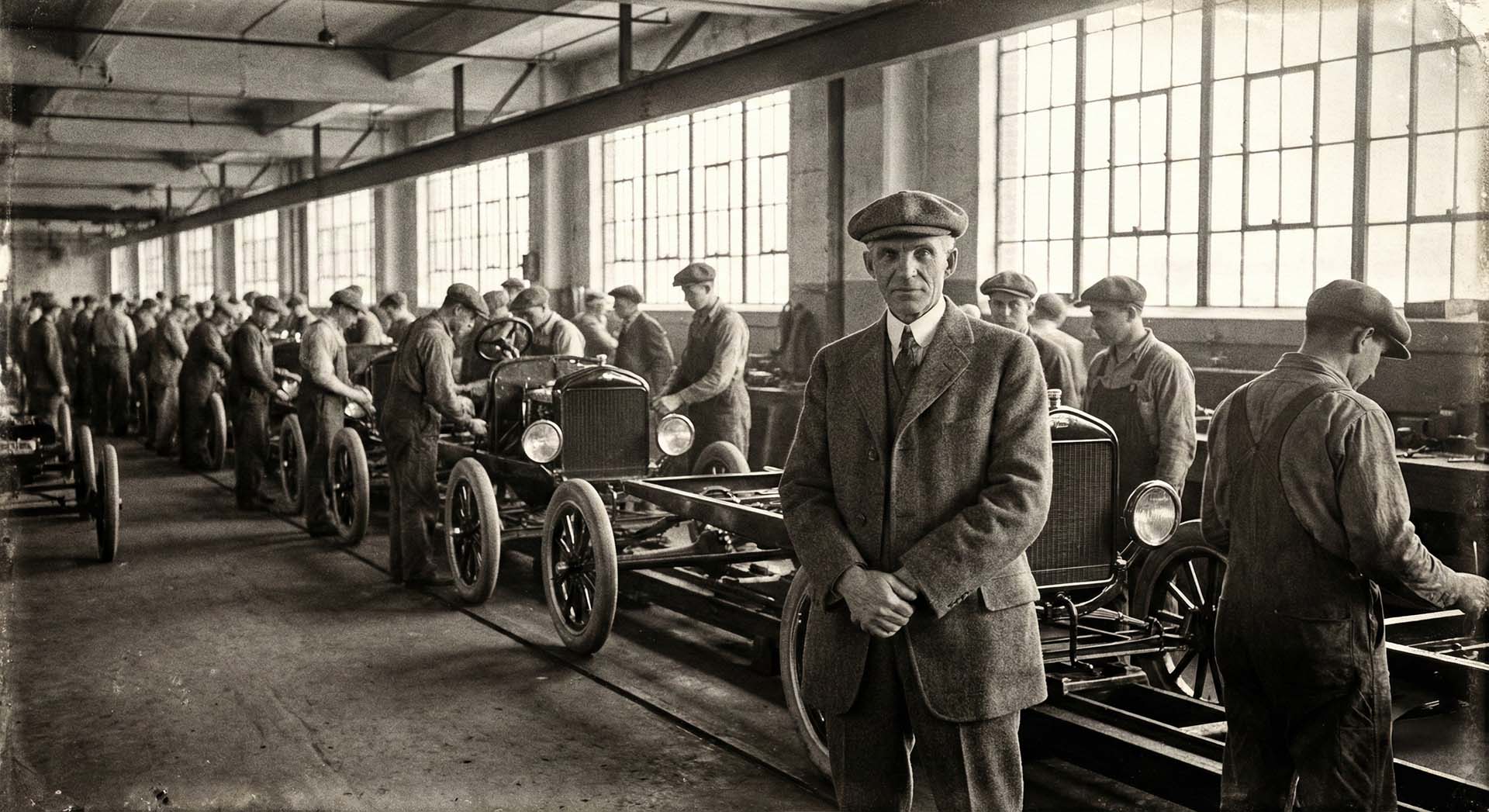
On January 5, 1914, Henry Ford did something Wall Street called insane.
He announced that Ford Motor Company would more than double the daily wage of its factory workers, from $2.34 to $5.00. He also cut the workday from nine hours to eight.
The business establishment predicted disaster. Competitors called it charity. Financial analysts said Ford had lost his mind. The Wall Street Journal accused him of injecting “spiritual principles into a field where they don’t belong.”
Instead of bankruptcy, Ford created an empire. Within two years, profits doubled from $30 million to $60 million. The company that was supposed to fail became the dominant force in American manufacturing.
What did Ford see that everyone else missed?
Before the $5 day, Ford’s Highland Park plant had a problem that doesn’t show up in most history books: turnover exceeded 300% annually. To maintain a workforce of 14,000, Ford had to hire more than 52,000 people every year.
Think about what that means operationally. Constant training of new workers. Quality inconsistencies on the line. Supervisors spending their days orienting people instead of improving processes. Institutional knowledge walking out the door faster than it could be built.
Ford wasn’t running a factory. He was running a revolving door with an assembly line attached.
The conventional wisdom said to optimize around this reality. Better hiring processes. Faster training programs. More supervisors. These are the solutions that look productive. They generate activity. They create jobs for consultants.
But Ford asked a different question: What if turnover isn’t a problem to manage, but a constraint to eliminate?
Most business leaders think about growth additively. More marketing. More salespeople. More locations. More products. More, more, more.
Ford thought subtractively. What friction could he remove? What constraint was bleeding the business dry?
The $5 day wasn’t an expense. It was surgery. He cut out the tumor of turnover and let the healthy tissue thrive.
After the announcement, turnover plummeted. Workers who had been job-hopping across Detroit’s factories suddenly had a reason to stay. Not just stay—but show up on time, work carefully, and protect their position. The best mechanics and machinists in the region lined up to work for Ford.
Training costs dropped. Quality improved. Supervisors could focus on optimization instead of orientation. The assembly line that Ford had pioneered could finally run the way it was designed to run.
Ford didn’t grow by adding more. He grew by removing the constraint that was preventing the system from performing.
There’s another dimension to this story that gets overlooked.
In 1914, $5 was a fortune for a factory worker. It was enough to buy a house. Enough to save. Enough to feed a family without your wife and children also working in factories. Enough to have a life outside the plant gates.
Ford gave his workers margin…financial margin that translated into time margin, energy margin, mental margin. Workers who weren’t exhausted from working two jobs showed up sharper. Workers who weren’t worried about next month’s rent could focus on the work in front of them.
And he gave them time margin directly by cutting the workday from nine hours to eight. One hour doesn’t sound like much. But it was an hour to see your kids before bed. An hour to eat dinner with your family. An hour that said: your life matters beyond what you produce for us.
The return on that investment showed up in ways that are hard to measure but impossible to miss. Discretionary effort. Pride in workmanship. Workers who actually cared whether the cars they built were any good.
Ford understood something that took business theory another hundred years to articulate: sustainable high performance requires margin. You cannot squeeze human beings indefinitely and expect quality output.
The Wall Street analysts who predicted Ford’s failure made a classic error. They were thinking in simple arithmetic: pay more, have less.
Ford was thinking systemically: pay more, keep your best people, train fewer replacements, improve quality, increase throughput, reduce defects, build reputation, and ultimately make more.
The critics saw an expense. Ford saw an investment in removing a constraint.
This is the mistake I see business owners make constantly. They look at their problems and ask: “How do I work around this?” instead of “What would happen if I eliminated this entirely?”
They optimize downstream of their constraints instead of removing the constraints themselves. They build elaborate systems to manage dysfunction instead of cutting out the dysfunction at its root.
It feels productive. It generates activity. But it’s the business equivalent of rearranging deck chairs while ignoring the hole in the hull.
Ford’s $5 day wasn’t charity. It wasn’t idealism. It wasn’t even primarily about creating a consumer class that could afford his cars, though that’s the story that gets told most often.
It was diagnosis. Ford looked at his business, identified the constraint that was actually limiting growth, and built a system to eliminate it.
The solution looked crazy because everyone else was looking at the wrong problem. They saw wages as a cost to minimize. Ford saw turnover as a constraint to remove. Same facts, different frame, completely different conclusion.
111 years later, the principle holds. Growth doesn’t always come from adding more. Sometimes the fastest path forward is removing what’s holding you back.
The question isn’t “What more can we do?” It’s “What constraint are we optimizing around instead of eliminating?”
Ford answered that question with a raise and an hour back. What’s your answer?
